
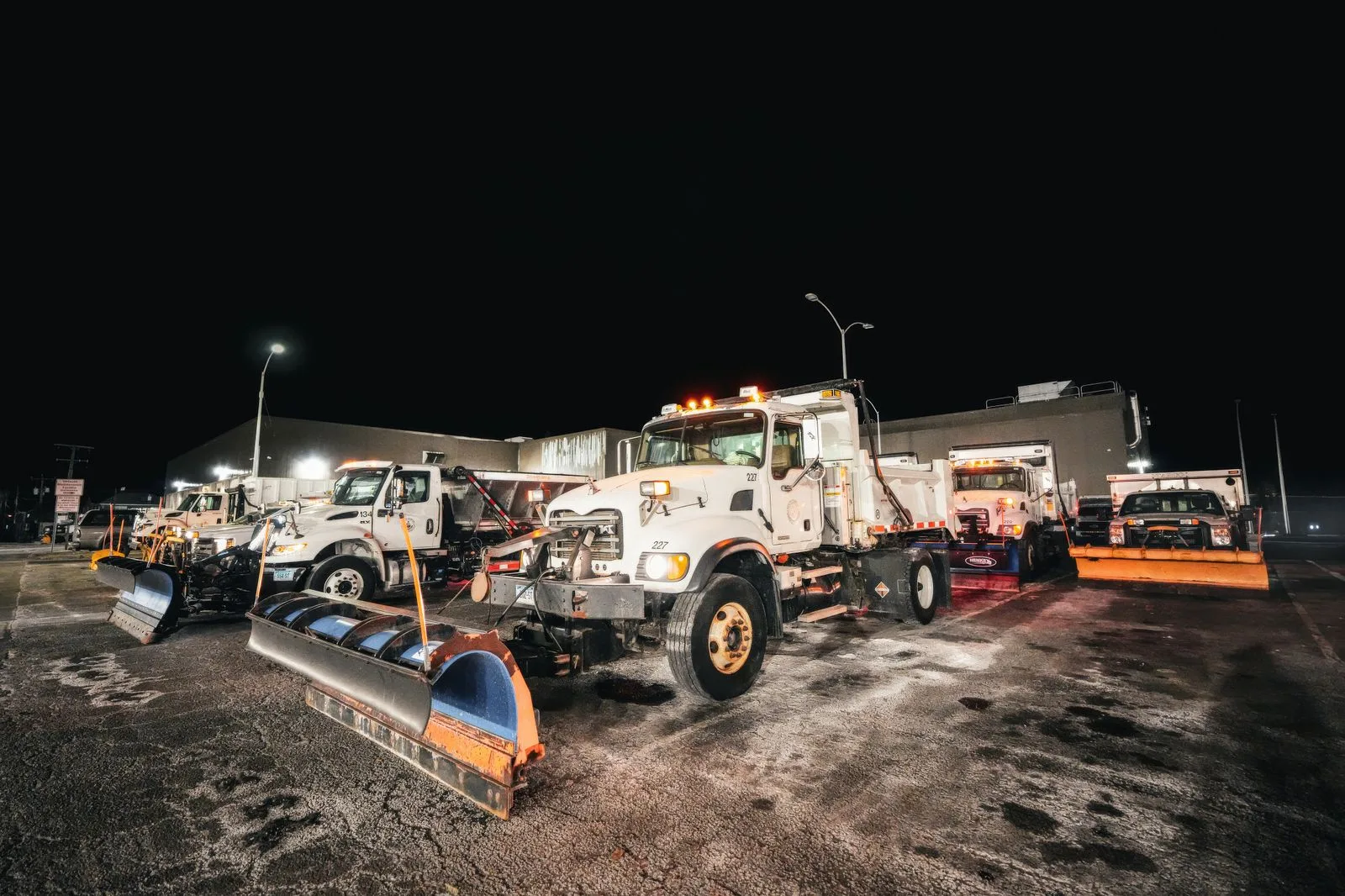
It starts at 2am so your lot is clear by seven
Snow and ice management across the GTA, Durham Region and Eastern Ontario. An agreed trigger depth, a priority route, and a time-stamped record of every single attendance — because that record is what defends you if someone falls.
Hiring a plow does not transfer the risk
Under Ontario's Occupiers' Liability Act the occupier keeps a duty to take reasonable care of the property. Putting a contractor on the lot does not extinguish it, and since Bill 118 an injured party has to serve written notice within 60 days — which means claims arrive fast, while memories are still being argued over.
What actually defends a claim is evidence that reasonable care was taken. Not a handshake. A record.
- Written scope naming every surface we are responsible for
- Agreed trigger depth and service standard, in the contract
- Date, time and crew logged for every attendance
- Surfaces treated and de-icing material used, recorded
- Records handed to you, not held hostage on our system
- Property owner named as additional insured on request
Three ways to buy winter
The right one depends on how much budget certainty you need and how much risk you want to carry. Pick a tab — we will tell you honestly which suits your site when we walk it.
One fixed price for the whole season
You pay the same figure whether it is a mild winter or a brutal one. We carry the risk of a heavy season; you carry the risk of a light one.
Best for: Budget certainty. Most commercial and institutional sites.
- Priority service after every event
- One predictable line in the operating budget
- Salting typically bundled or quoted alongside
- Best value when a season runs long
A flat fee each time we clear
We attend and invoice each time accumulation reaches the agreed trigger depth. A single long storm may be billed as more than one push if it keeps falling.
Best for: Lower-traffic lots and sites that can tolerate a higher trigger.
- You pay only for events that actually happen
- Costs track the winter rather than a forecast
- Needs a clear written definition of what counts as one push
- Harder to budget in an unpredictable season
Clearing and de-icing priced separately
Plowing is triggered by depth; salting is triggered by conditions. Freezing rain and melt-refreeze cycles get attention even when nothing has accumulated.
Best for: Sites where ice, not accumulation, is the real risk.
- Ice events covered, not just snowfall
- Anti-icing before a storm where forecast allows
- Separate line items make the invoice readable
- Most defensible record for a slip-and-fall claim
TODO(Cole): add indicative seasonal and per-push ranges once you are comfortable publishing them. Snow buyers shortlist on price band more than almost any other trade.
What is in the contract
Everything below is part of the quoted price. Anything not on this list for your site gets said out loud before you sign, not discovered in February.
- Site walk before the season, with a marked plan of curbs, islands, hydrants and drains
- Marker stakes set at the lot edges so nothing is clipped under snow cover
- Agreed trigger depth, priority order and where snow is to be stacked
- Plowing and shovelling to the surfaces named in the contract
- Walkways, entrances and accessible routes cleared, not just the driving lanes
- De-icing material applied to the agreed standard
- Windrow at driveway and entrance cleared rather than left for you
- Time-stamped service record for every attendance
- Snow relocation or haul-off when stacking areas fill
How a storm actually runs
From the forecast to the record that lands in your inbox.
-
Forecast watch
We track the forecast against your trigger depth and priority tier, and pre-treat where conditions and timing allow.
24 to 48 hours out
-
Dispatch
Crews are assigned by route and priority. Hospitals, schools and early-open commercial sites are cleared first.
As accumulation reaches trigger
-
Clearing
Lots plowed to the marked plan, snow stacked in the agreed areas, walkways and entrances shovelled and treated.
Through the event
-
De-icing
Material applied to the agreed standard, with particular attention to melt-refreeze across the overnight low.
On completion and as conditions require
-
Service record
Attendance logged with date, time, crew, surfaces treated and material used. This is what your insurer asks for.
Same event
-
Return visits
Continuing accumulation or a refreeze brings us back. Stacking areas are relocated before they start eating parking.
As required
Sites we hold routes for



Questions about winter contracts
What is a trigger depth, and what should ours be?
The accumulation at which we automatically attend without you calling. Five centimetres is the common residential figure. Commercial sites with early foot traffic usually set it lower, around two to five centimetres, because the risk is people arriving before opening rather than the depth itself. Lower triggers mean more visits and a higher seasonal price; we will tell you plainly which band your site belongs in.
Seasonal or per push — which actually costs less?
Over a single winter, whichever one the weather happens to favour. Seasonal moves the risk of a heavy year onto us and gives you one predictable number. Per push costs less in a mild year and more in a hard one. Most commercial and institutional clients choose seasonal because a fixed line in the budget is worth more than the chance of saving in a quiet February.
If someone slips on our lot, are we covered because we hired you?
Not automatically, and anyone telling you otherwise is selling. Under Ontario's Occupiers' Liability Act the occupier keeps a duty to take reasonable care, and hiring a contractor does not extinguish it. What protects you is evidence that reasonable care was taken — a written scope, an agreed standard, and a time-stamped record of every attendance. That is precisely why we log and hand over service records rather than treating them as paperwork.
How quickly do you attend after a storm starts?
TODO(Cole): confirm the response window you are prepared to commit to in writing, and whether it differs by priority tier. A stated response time is one of the strongest things on a commercial snow page, and it has to be a number you can defend when a client holds you to it at 5am.
Do you clear the ridge the city plow leaves across the driveway?
Yes. The windrow is the thing most people actually resent, and it is explicitly in scope. It is also the part some contracts quietly exclude, so it is worth checking on any quote you compare against ours.
What de-icing material do you use, and what about salt damage?
TODO(Cole): confirm which products you carry, whether you hold Smart About Salt certification, and whether you offer a reduced-salt or brine option. Ontario clients increasingly ask about over-salting because of concrete and landscape damage and the environmental reporting side.
What insurance do you carry, and can we be named?
We carry $5M liability coverage and WSIB in good standing, and we are COR™ certified by IHSA. Naming the property owner as additional insured is a normal request on a commercial snow contract and we are comfortable with it. TODO(Cole): confirm whether additional-insured endorsements are included as standard or priced separately.
When do contracts need to be signed?
Earlier than most people expect. Routes are built before the season so crews, equipment and salt are committed against known sites. TODO(Cole): confirm your cut-off date so this page can state it plainly.
Get a winter quote
Tell us the site and roughly how much hard surface there is. We walk it, mark the plan, and send a written scope with a fixed seasonal price or a per-push rate.